Bedroom singer
A strong lead take has steady fan noise beneath quieter lines.
Listen for less noise between phrases without losing soft consonants or the tail of a held note.
ai voice enhancerRecorded vocals
A voice enhancer for singing is most useful when a good take has distracting hiss, room sound, or uneven clarity. Start with the recording you like, then judge any processing by whether it still sounds like you.

A singing take needs a different listening test from speech. These related guides separate general voice cleanup from other recording goals.
The aim is an easier listen, not a different singer. These recording situations call for different checks after enhancement.
A strong lead take has steady fan noise beneath quieter lines.
Listen for less noise between phrases without losing soft consonants or the tail of a held note.
ai voice enhancerA quick guide vocal has room reflections that make words less distinct.
Check whether the lyric becomes easier to follow while the voice still sits naturally in the demo.
voice enhancer online freeA lesson recording needs intelligible instructions as well as an honest example of the sung phrase.
Compare speech and singing separately; settings that flatter narration may obscure the detail of a note.
podcast voice enhancerSeveral takes need a consistent listening check before one is selected.
Keep an untouched reference so cleanup does not become the reason for choosing a weaker performance.
how to use voice enhancer onlineA short review loop helps you decide whether enhancement serves the song.
Start with the vocal whose pitch, timing, and expression already work. Keep the original recording available for a fair comparison.
Identify a specific issue, such as steady hiss or distracting room sound. Avoid asking for a completely different tone when the performance is the part you want to preserve.
Switch between the original and processed versions at a quiet phrase, a breath, and a sustained note. Listen in the context of the music as well as on its own.
Processing may reduce distractions, but it cannot replace a well-captured vocal or repair every flaw without trade-offs.
If a loud phrase clipped during recording, the original waveform has already lost information. Cleanup may change the artifact, not restore the exact performance.
Workaround
Record another take with more input headroom when possible.
When accompaniment or backing voices are baked into one recording, attempts to isolate the lead may also affect musical detail.
Workaround
Use a separate vocal recording when you have one, and compare the result against the full mix.
Noise reduction does not substitute for phrasing, breath control, pitch practice, or a take that conveys the lyric.
Workaround
Choose the strongest performance first; treat enhancement as a finishing check.
Heavy processing can mistake breaths, vibrato texture, or quiet endings for unwanted sound.
Workaround
Recheck the most delicate phrases and prefer a less processed version when expression suffers.
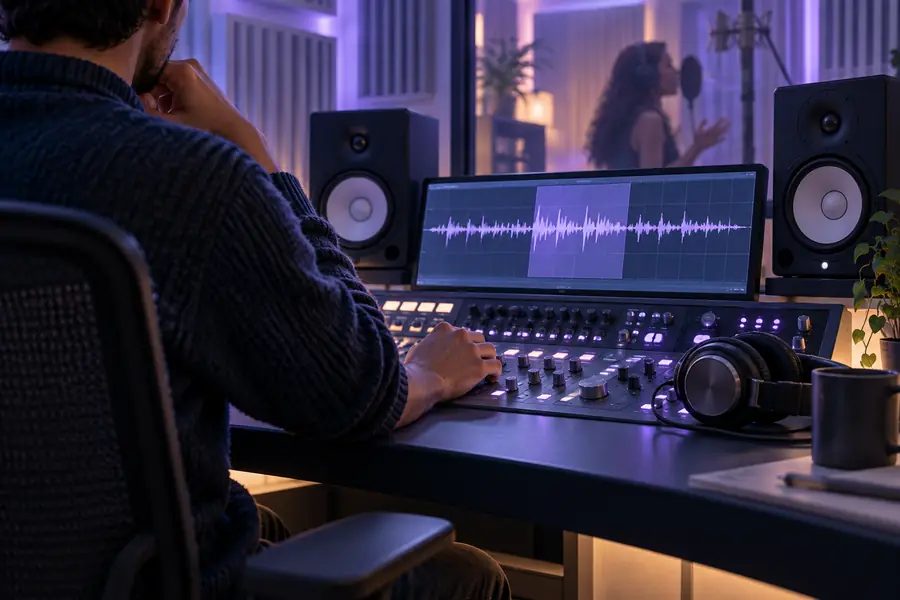
This visual is an illustration of the review process, not an audio sample or a promise of a particular result.
 Original take
 Reviewed take
Use the same short passage for both listens. The processed take earns its place only if its benefits outweigh changes to the performance.
Background sound
Original vocal
May remain audible under quiet phrases
Processed vocal
May be less distracting; check for new artifacts
Breaths
Original vocal
Captured as performed
Processed vocal
Check that intentional breaths still sound natural
Held notes
Original vocal
Original tone and decay
Processed vocal
Listen for steady tone and a complete ending
Consonants
Original vocal
May compete with room noise
Processed vocal
Check clarity without brittle or missing sounds
Dynamics
Original vocal
Original contrast between soft and loud lines
Processed vocal
Confirm that the contrast still supports the song
Final decision
Original vocal
Reference for the singer's intent
Processed vocal
Use only if it works better in the full mix
Try Voiceenhancer as a starting point for reviewing a recorded vocal. Compare it with your original take before deciding whether the change helps the song.
Enhance my vocalIt may help a recorded take sound clearer by reducing some distractions. It does not teach technique or turn an unconvincing performance into a strong one, so choose the take for its singing first.
It can, particularly when processing is too strong or the recording has difficult background sound. Compare breaths, vibrato, consonants, and held notes with the original to decide whether the vocal still sounds like you.
You can assess a mixed recording, but music overlapping the voice makes selective cleanup harder. A separate vocal track gives you a clearer reference and more room to judge changes without affecting the accompaniment.
Choose the take for pitch, timing, phrasing, and feeling before judging cleanup. Keep its unprocessed version so a quieter background does not persuade you to use a less expressive performance.
Listen to the same passages in both versions, including a quiet line and a sustained note. Then play each with the rest of the song; the better choice is the one that improves clarity without sacrificing expression.