Voiceenhancer Explore voice tools
English

Audio decision guide

Choosing between voice enhancer vs ai audio

The difference between voice enhancer vs ai audio is mainly a difference in intent: one improves an existing recording while the other may interpret, transform, or generate sound. Use this comparison to match the method to your source, goal, and tolerance for change.

Related audio guides

Use these nearby guides to clarify the terminology, tools, and workflow before you process a recording.

How the two approaches work

Both paths begin with recorded audio, but they ask different questions of it. A useful comparison follows the signal from source material to the listener’s final impression.

  1. 1

    Identify the source

    Listen for the main issue first: low volume, room echo, background noise, uneven delivery, or a need for a deliberately different voice. A clear diagnosis prevents unnecessary processing.

  2. 2

    Choose the intervention

    Use enhancement when the speaker and performance should remain recognisably the same. Consider AI audio techniques when the goal includes transformation, reconstruction, synthesis, or a new creative interpretation.

  3. 3

    Review the result

    Compare the processed version with the original at a comfortable listening level. Check consonants, breaths, room tone, musical detail, and whether the result still sounds natural for its audience.

Three checks before you choose

These checkpoints keep the comparison grounded in the recording itself rather than in the label attached to a tool.

Start with the original recording and preserve an untouched reference.
1 source
Separate clarity goals from transformation goals before processing.
2 goals
Review speech intelligibility, naturalness, and unwanted artifacts.
3 checks
Test with the intended audience, not only through studio headphones.
4 listeners

Hear the difference in intent

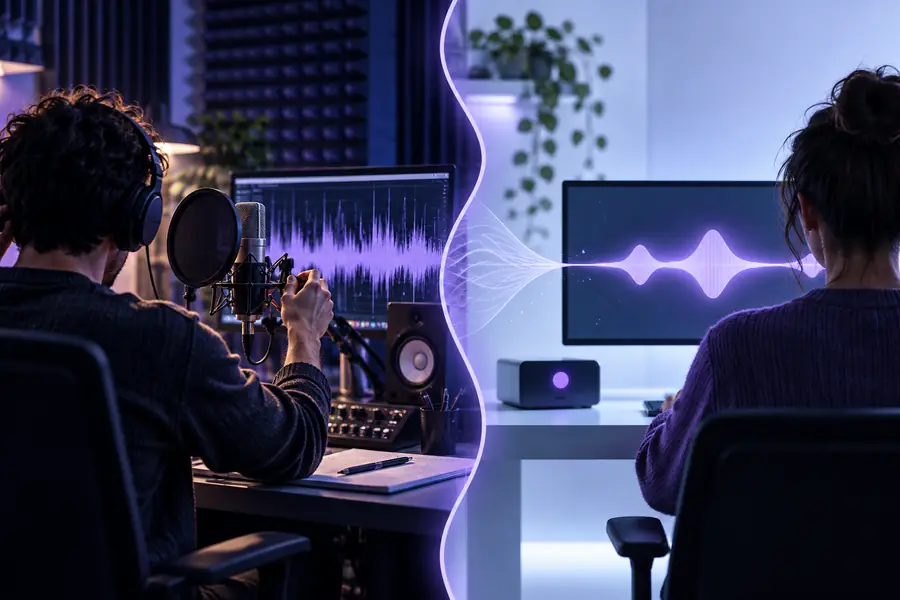
The visual pair represents the practical distinction: enhancement aims to make the same speaker easier to understand, while AI audio may make a more substantial change to the source.

Unprocessed spoken recording with uneven room sound Original source
Audio comparison interface showing a refined voice track Processed result
Compare identity, clarity, texture, and artifacts—not loudness alone.

Where each approach fits

The best choice depends on what must remain stable. These examples show how the decision changes across creators, speakers, and production contexts.

Podcast host

A host has clear ideas and a usable performance, but the room adds mild echo and the recording level varies between sentences.

A voice-focused workflow can improve consistency while keeping the host’s timing, character, and wording intact. See the dedicated podcast workflow in the podcast voice enhancer guide.

podcast voice enhancer

Singer or songwriter

A vocalist wants a more intelligible demo without losing the phrasing, breath, and emotional character already captured in the take.

Start with conservative enhancement and listen for changes to sibilance, dynamics, and expressive detail. The voice enhancer for singing guide covers this musical context.

voice enhancer for singing

Video creator

A creator records narration in a home office and needs dialogue to sit clearly beside music, effects, or visual cuts.

Enhancement is usually the more predictable first step when the words and speaker identity are already right. An online voice enhancer workflow can help organise the review.

voice enhancer online free

Experimental producer

A producer wants to move beyond cleanup and explore a changed vocal texture, reconstructed phrase, or deliberately synthetic result.

AI audio may be appropriate when transformation is part of the brief, but the producer should compare artifacts, consent, identity, and editability before committing.

ai voice enhancer

Limits and edges

Neither approach is a universal repair button. The table below separates the usual strengths from the situations that deserve extra care.

Voice enhancement
AI audio

Primary purpose

Voice enhancement

Improve the intelligibility, balance, or perceived quality of an existing voice recording.

AI audio

Analyse, transform, reconstruct, or generate audio beyond straightforward cleanup.

Speaker identity

Voice enhancement

Usually aims to preserve the original speaker and performance.

AI audio

May preserve, alter, imitate, or replace vocal characteristics depending on the method.

Best starting material

Voice enhancement

A recognisable recording with speech or singing that is already present.

AI audio

A defined creative or technical task where interpretation or synthesis is acceptable.

Typical control

Voice enhancement

Focuses on practical adjustments such as clarity, presence, balance, and noise management.

AI audio

Can introduce broader controls over voice, style, content, or sonic character.

Main risk

Voice enhancement

Over-processing can create harshness, pumping, muffled consonants, or an unnatural room impression.

AI audio

The result may contain artifacts, identity changes, timing issues, or details that were not in the source.

Review priority

Voice enhancement

Check whether the same speaker remains clear, natural, and suitable for the delivery context.

AI audio

Check whether the transformation is intentional, believable, permitted, and consistent with the brief.

When it is a poor fit

Voice enhancement

It cannot reliably invent missing words or restore every detail lost to severe clipping or distortion.

AI audio

It may be excessive when the only problem is modest noise, uneven volume, or room coloration.

Useful decision question

Voice enhancement

Would I be happy if the listener heard the same performance more clearly?

AI audio

Do I need the audio to become something meaningfully different from the source?

Choose the method that protects your intent

If the recording already contains the performance you want, begin with a voice-focused improvement and judge the result by clarity and naturalness. If the brief calls for transformation, reconstruction, or a new sonic identity, evaluate AI audio as a different category of intervention. Keep the original, compare deliberately, and let the listener’s experience decide.

Start improving audio
  • Preserve the original before processing
  • Separate cleanup from creative transformation
  • Review the result for naturalness and artifacts

voice enhancer vs ai audio FAQ

A voice enhancer generally improves an existing recording while trying to preserve the speaker, wording, and performance. AI audio is a broader category that can include enhancement, transformation, reconstruction, or generation, so its effect may extend beyond cleanup.

No. The better option depends on the goal and the source recording. If the performance is already right and only needs clearer delivery, a focused enhancement workflow may be more predictable than a broader transformation.

It can often improve intelligibility and reduce some distracting problems, but it cannot guarantee recovery of information that was never captured or was severely clipped. Heavy processing may also introduce harshness, pumping, or an artificial texture.

Consider AI audio when the brief calls for a changed vocal character, reconstructed material, synthesis, or another creative result beyond straightforward cleanup. Review identity, consent, artifacts, and whether the output still serves the intended audience.

Keep the original recording and compare both versions at a similar listening level. Check speech intelligibility, consonants, breaths, room tone, timing, speaker identity, and unwanted artifacts rather than judging only by which version sounds louder.

Explore voice tools
Explore voice tools